API Reference
SDK version: 0.1.9 Scope: Hub catalog client • local installer (files, artifacts, env, runner discovery) • lightweight runtime
This SDK provides three pillars:
- MatrixClient — search the Hub, read entities, request install plans.
- LocalInstaller — materialize a plan locally (files, artifacts, env,
runner.json). - runtime — start/stop/list/tail/doctor local MCP servers (no daemon).
New in 0.1.9
- The installer has been refactored into a proper subpackage:
matrix_sdk/installer/.- Backwards-compatible import:
from matrix_sdk.installer import LocalInstallerstill works.- More robust runner discovery (URLs, embedded manifests, shallow search, structural inference).
- Environment prep parity with the legacy installer (Python venv + pip indices, Node PM autodetect).
- New/expanded env toggles (see Environment variables).
MatrixClient
Location: matrix_sdk.client.MatrixClient
Errors: raises matrix_sdk.client.MatrixError(status, detail) on non-2xx.
class MatrixClient:
    def __init__(
        self,
        base_url: str,
        token: str | None = None,
        *,
        timeout: float = 15.0,
        **kwargs
    ) -> None: ...

    # Catalog
    def search(
        self,
        q: str,
        *,
        type: str | None = "any",
        limit: int = 10,
        capabilities: str | None = None,
        frameworks: str | None = None,
        providers: str | None = None,
        mode: str | None = None,
        include_pending: bool = False,
        with_snippets: bool = False,
        with_rag: bool = False,
        rerank: str | None = "none",
    ) -> dict: ...

    def entity(self, id: str) -> dict: ...
    def install(self, id: str, *, target: str, **kwargs) -> dict: ...

    # Remotes
    def list_remotes(self) -> list | dict: ...
    def add_remote(self, url: str, *, name: str | None = None) -> dict: ...
    def delete_remote(self, name: str) -> dict: ...
    def trigger_ingest(self, name: str) -> dict: ...
Notes
entity(id)URL-encodesidinternally.install(id, target)calls Hub/catalog/installand returns the Hub payload (plan/results/etc).- Treat
type="any"(orNone) as “no filter”.
Deep links
Location: matrix_sdk.deep_link
Errors: InvalidMatrixUri for bad/unsupported URIs.
from matrix_sdk.deep_link import parse, handle_install, InvalidMatrixUri

dl = parse("matrix://install?id=tool%3Ahello%400.1.0&alias=hello")
# -> DeepLink(action='install', id='tool:hello@0.1.0', alias='hello')

res = handle_install(url, client, target="/abs/install/dir")
# -> HandleResult(id=..., target=..., response=<hub install payload>)
Rules:
- Only
matrix://installis supported. idis required;aliasmust match^[a-z0-9][a-z0-9._-]{0,63}$.
LocalInstaller
Location: matrix_sdk.installer.LocalInstaller
Data classes: BuildReport, EnvReport, BuildResult
Other errors: matrix_sdk.manifest.ManifestResolutionError, ArchiveFetchError, GitFetchError.
from matrix_sdk.installer import LocalInstaller

installer = LocalInstaller(client)

result = installer.build(
    "mcp_server:hello-sse-server@0.1.0",
    alias="hello-sse",
    # target defaults via policy if omitted
)

print(result.target)         # install directory
print(result.env.python_prepared, result.env.node_prepared)
print(result.build.files_written, result.build.artifacts_fetched)
print(result.runner)         # contents of runner.json (dict)
Public dataclasses (exact fields)
from dataclasses import dataclass
from typing import Any, Dict, Optional

@dataclass(frozen=True)
class BuildReport:
    files_written: int
    artifacts_fetched: int
    runner_path: Optional[str]

@dataclass(frozen=True)
class EnvReport:
    python_prepared: bool
    node_prepared: bool
    notes: Optional[str] = None

@dataclass(frozen=True)
class BuildResult:
    id: str
    target: str
    plan: Dict[str, Any]
    build: BuildReport
    env: EnvReport
    runner: Dict[str, Any]
Lifecycle
-
plan(id, target)→ ask Hub for an install plan Sends a server-safe target label by default (e.g.alias/version). UseMATRIX_INSTALL_SEND_ABS_TARGET=trueto send the absolute path. -
materialize(outcome, target)→ write declared files, fetch artifacts, ensure/validaterunner.jsonScansplan.files,results[].files, and top-levelfiles. Supportscontent(text) andcontent_b64(binary). -
prepare_env(target, runner)→ create.venv(Python) and/or runpnpm|yarn|npm install(Node) Python: upgrades pip/setuptools/wheel; respects pip index envs; installs fromrunner.python.requirements,requirements.txt, or local project (pyproject.toml/setup.py) with optional editable mode. Node: auto-detects package manager from lockfiles unless overridden. -
build(id, …)→ runs all three steps and returnsBuildResult.
Methods (signatures & behavior)
class LocalInstaller:
    def __init__(self, client: MatrixClient, *, fs_root: str | Path | None = None): ...

    def plan(self, id: str, target: str | os.PathLike[str]) -> dict: ...
    # Sends server-safe label unless MATRIX_INSTALL_SEND_ABS_TARGET=true

    def materialize(self, outcome: dict, target: str | os.PathLike[str]) -> BuildReport: ...
    # Writes files, fetches artifacts, and writes runner.json via discovery chain

    def prepare_env(
        self,
        target: str | os.PathLike[str],
        runner: dict,
        *,
        timeout: int = 900
    ) -> EnvReport: ...
    # Python venv + pip install and/or Node install

    def build(
        self,
        id: str,
        *,
        target: str | os.PathLike[str] | None = None,
        alias: str | None = None,
        timeout: int = 900
    ) -> BuildResult: ...

    def _load_runner_from_report(self, report: BuildReport, target_path: Path) -> dict: ...
    # Prefers report.runner_path, falls back to target/runner.json
Runner discovery (strategy order)
The installer uses a deterministic chain and stops at the first valid result:
plan.runner_b64→ decode → validate → writeplan.runner_url(relative resolved against provenance) → fetch JSON → validate → writeplan.runner(object) → validate → write- Embedded manifest (v2):
manifest.runner→ validate → write - Embedded manifest (v1): extract server URL → synthesize connector runner (
/sse) → write - Local file:
runner_fileorrunner.json - Shallow BFS for
runner.json(depth =MATRIX_SDK_RUNNER_SEARCH_DEPTH, default 2) - Manifest URL (
plan.manifest_urlorprovenance.source_url), whenMATRIX_SDK_ALLOW_MANIFEST_FETCH=true: fetch → parse → synthesize connector → write - Structural inference: infer minimal
python/noderunner from files (e.g.,server.py,package.json) → write - Last-ditch: if any MCP/SSE URL hint is present, synthesize a minimal connector
A valid process runner must include
"entry"and"type": "python"|"node". A valid connector runner must include"type": "connector"and"url".
runtime
Location: matrix_sdk.runtime
State/Logs: ~/.matrix/state/<alias>/runner.lock.json, ~/.matrix/logs/<alias>.log
Model: LockInfo(pid:int, port:int|None, alias:str, target:str, started_at:float, runner_path:str)
from matrix_sdk import runtime

lock = runtime.start("/path/to/install", alias="hello-sse")  # reads runner.json
# uses venv python for python runners; finds a free port if needed

runtime.status()              # -> list[LockInfo]
runtime.doctor("hello-sse")   # -> {"status": "ok"|"fail", "reason": "..."}
runtime.stop("hello-sse")     # -> bool
for line in runtime.tail_logs("hello-sse", n=40): print(line, end="")
runtime.log_path("hello-sse") # -> str
Requirements
runner.jsonmust define at least:{"type": "python"|"node", "entry": "…"}- Python runners: venv Python must exist (created during
prepare_env).
Artifact fetchers
HTTP archives
Location: matrix_sdk.archivefetch
API:
from matrix_sdk.archivefetch import fetch_http_artifact, ArchiveFetchError

fetch_http_artifact(
    url: str,
    target: pathlib.Path | str,
    dest: str | None = None,        # optional: also save raw file at target/dest
    sha256: str | None = None,      # optional integrity
    unpack: bool = False,           # auto-detects .zip/.tar(.gz) too
    timeout: int | float = 60,
    logger: logging.Logger | None = None,
)
- Safe ZIP/TAR extraction (no path traversal).
- Optional flatten of GitHub-style single-folder archives.
Git repos
Location: matrix_sdk.gitfetch
API:
from matrix_sdk.gitfetch import fetch_git_artifact, GitFetchError

fetch_git_artifact(
    spec: Mapping[str, object],     # {repo, ref, depth?, subdir?, strip_vcs?, recurse_submodules?, lfs?, verify_sha?}
    target: pathlib.Path,
    git_bin: str = "git",
    allow_hosts: Iterable[str] | None = None,  # defaults via env/standard hosts
    timeout: int = 180,
    logger: logging.Logger | None = None,
)
- HTTPS by default; host allow-list enforced (deny-by-default if none given).
- Shallow clone, optional sparse subdir, optional LFS, optional commit verification.
Schemas (Pydantic)
Location: matrix_sdk.schemas
Models mirror Hub responses; unknown fields are allowed.
SearchItem,SearchResponseEntityDetail(extra fields allowed; includes manifest-ish + computed fields)InstallStepResult,InstallOutcomeMatrixAPIError(generic error wrapper)
Exceptions
matrix_sdk.client.MatrixError(status, detail)— Hub non-2xx.matrix_sdk.deep_link.InvalidMatrixUri— deep-link parse/validation errors.matrix_sdk.manifest.ManifestResolutionError— manifest/artifact integrity/host violations.matrix_sdk.archivefetch.ArchiveFetchError— download/unpack errors.matrix_sdk.gitfetch.GitFetchError— git materialization errors.
Environment variables
General
| Variable | Meaning | Default |
|---|---|---|
MATRIX_SDK_DEBUG |
Enables verbose DEBUG logging for installer/runtime/archivefetch. | off |
MATRIX_HOME |
Base dir for ~/.matrix (state/logs). |
user home |
MATRIX_INSTALL_SEND_ABS_TARGET |
Send absolute install path to Hub during plan() (instead of server-safe label). |
off |
Installer — runner discovery
| Variable | Meaning | Default |
|---|---|---|
MATRIX_SDK_RUNNER_SEARCH_DEPTH |
Depth for shallow runner.json search. |
2 |
MATRIX_SDK_ALLOW_MANIFEST_FETCH |
Permit fetching a remote manifest to synthesize a connector runner. | 1 |
MATRIX_SDK_MANIFEST_DOMAINS |
CSV allow-list of domains allowed for remote manifest fetches. | (allow all) |
MATRIX_SDK_ENABLE_CONNECTOR |
Allow synthesizing connector runners from URL hints. | 1 |
MATRIX_SDK_HTTP_TIMEOUT |
Network timeout (seconds) for installer fetches. | 15 |
Installer — Python deps
| Variable | Meaning | Default |
|---|---|---|
MATRIX_SDK_PIP_INDEX_URL |
Primary pip index URL. | pip default |
MATRIX_SDK_PIP_EXTRA_INDEX_URL |
Extra pip index URL. | none |
MATRIX_SDK_PIP_EDITABLE |
Install local project as editable (pip install -e .). |
1 |
Git fetcher
| Variable | Meaning | Default |
|---|---|---|
MATRIX_GIT_ALLOWED_HOSTS |
CSV allow-list for git clone hosts. | common hosts |
MATRIX_GIT_ALLOW_INSECURE |
Allow http:// git (discouraged). |
off |
MATRIX_SDK_DEBUG_GIT |
Extra git logs. | off |
Search
Location: matrix_sdk.search
Purpose: Thin, defensive wrappers around GET /catalog/search with normalization, small retries, and optional mode fallbacks.
from matrix_sdk.search import search, search_try_modes, SearchOptions
search(...)
def search(
    client: "MatrixClient",
    q: str,
    *,
    type: str | None = None,                           # "agent" | "tool" | "mcp_server" | "any"/None
    capabilities: "Iterable[str] | str | None" = None, # list/tuple/set or CSV -> CSV
    frameworks: "Iterable[str] | str | None" = None,   # list/tuple/set or CSV -> CSV
    providers: "Iterable[str] | str | None" = None,    # list/tuple/set or CSV -> CSV
    mode: str | None = "hybrid",                       # "keyword" | "semantic" | "hybrid"
    limit: int = 5,                                    # clamped to 1..100
    with_rag: bool = False,                            # add fit_reason if supported
    with_snippets: bool = False,                       # add snippet if supported
    rerank: str | None = "none",                       # "none" | "llm"
    include_pending: bool = False,
    options: "SearchOptions | None" = None,            # retries, fallbacks, typed return
) -> dict | "SearchResponse": ...
Behavior
- Normalizes filters (lists/sets → CSV), clamps
limit. - Retries transient 5xx/network errors with exponential backoff.
- Optional fallback chain across modes (e.g., semantic → hybrid → keyword) when no results.
- Returns a
dictby default, or a typedSearchResponseifoptions.as_model=True.
Example
from matrix_sdk.client import MatrixClient
from matrix_sdk.search import search, SearchOptions

hub = MatrixClient("https://api.matrixhub.io")

# Hybrid with fallbacks; typed response
res = search(
    hub, "hello world", type="mcp_server",
    options=SearchOptions(as_model=True, max_attempts=3)
)
print(res.total, [it.id for it in res.items])
SearchOptions
from dataclasses import dataclass
from typing import Tuple

@dataclass(frozen=True)
class SearchOptions:
    allow_fallback: bool = True                         # try more modes when no results
    fallback_order: "Tuple[str, ...] | None" = None     # override mode order
    max_attempts: int = 2                               # transient retry attempts
    backoff_base: float = 0.1                           # seconds; jittered exponential
    as_model: bool = False                              # return pydantic SearchResponse
Defaults:
- If
fallback_orderis not provided, the helper picks a sensible chain based on the initialmode. max_attemptsapplies to each HTTP attempt (initial + each fallback).
search_try_modes(...)
def search_try_modes(
    client: "MatrixClient",
    q: str,
    modes: "Sequence[str]" = ("hybrid", "keyword", "semantic"),
    **kwargs,
):
    """Yield (mode, response) for each mode (no fallbacks)."""
    ...
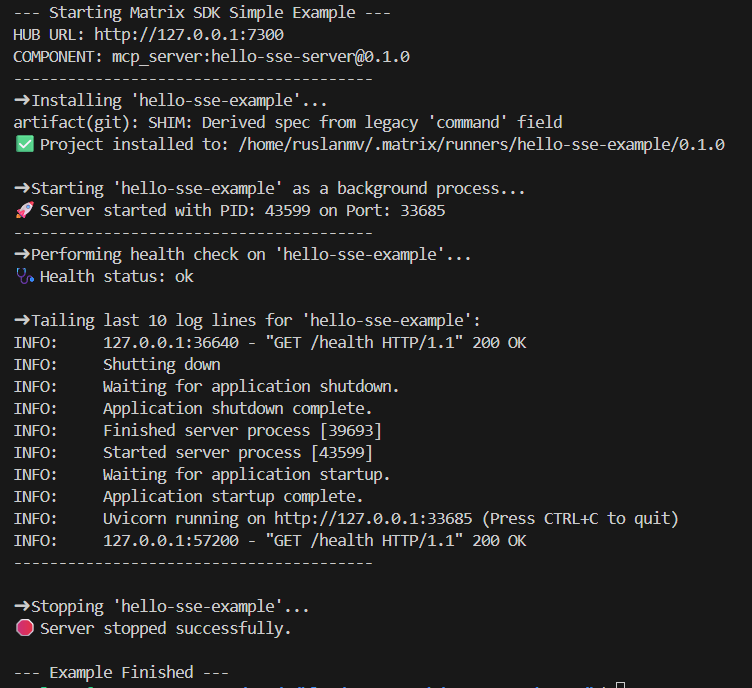
End-to-end example
from matrix_sdk.client import MatrixClient
from matrix_sdk.installer import LocalInstaller
from matrix_sdk import runtime

# 1. Initialize the client and installer
client = MatrixClient(base_url="https://api.matrixhub.io")
installer = LocalInstaller(client)

# 2. Build the project locally
result = installer.build("mcp_server:hello-sse-server@0.1.0", alias="my-server")
print(f"✅ Project installed to: {result.target}")

# 3. Start the server using the runtime module
server = runtime.start(result.target, alias="my-server")
print(f"🚀 Server started with PID {server.pid} on port {server.port}")

# 4. Check status and stop the server
print(f"ℹ️ Current status: {runtime.status()}")
runtime.stop("my-server")
print("🛑 Server stopped.")
Compatibility notes (0.1.9)
- The legacy
matrix_sdk/installer.pymodule has been split into thematrix_sdk/installer/package. - Import compatibility is preserved:
from matrix_sdk.installer import LocalInstaller(and the dataclasses) still works. - A few helpers are also re-exported for downstream compatibility:
_is_valid_runner_schema,_ensure_sse_url,_url_from_manifest,_extract_mcp_sse_url,_coerce_runner_to_legacy_process.
Requirements
- Python 3.11 – 3.12 (per
pyproject.toml).